Sunday, July 10, 2016

get moving

St. Thomas' Church, Whitemarsh
Proper 10, Year C, 2016


My friends, between Orlando and Turkey and Bangladesh and Iraq, this has been a rough month. This past week has been especially difficult for our country: Baton Rouge, Minneapolis, Dallas. So much violence. So much pain. So much loss. In the face of all that has happened, we gather together today with hearts weighed down with sorrow, anger, fear, disgust, and grief. I want to assure you that these are all appropriate responses. In times like these it is important to name our emotions and to give ourselves the space to feel them—not to act out from the place of pain, but to acknowledge that these feelings are there. I read somewhere this week that someone felt a small glimmer of hope in that she was still moved to tears at these events, that she hadn’t become completely desensitized to them.

In the midst of all that has happened nationally and globally, and with whatever else we are carrying with us from our personal lives, we turn to the Holy Gospel for guidance. And, as is so often the case, the words of Scripture are pertinent and speak directly to us. The Parable of the Good Samaritan. How often have we heard this story? If you’re like me, this story has become so familiar that you tend to gloss over it. But there are still lessons to be learned within this tale.

We are familiar with the premise: a man gets beaten up and lies near death on the side of the road, the religious leaders who should stop and help don’t, and the person we would least expect to help does. I’ve mentioned before that in Jesus’ time the Samaritans are rivals of the Jews. They hate each other, and so for the people listening to Jesus’ story, the fact that a Samaritan is the hero, the one who stops when the leaders of their faith don’t, is a shocking and even outrageous idea.

Over time many people have retold this story, setting the scene in their own day and age and changing the Samaritan to someone hated or looked down upon or feared by their society: the Good Samaritan is replaced with a member of the Inquisition, an oil baron, a Nazi, a Communist, a white supremacist, a Black Panther, a gang member, a terrorist, a politician, an immigrant…you get the idea.

This person whom we dislike so much sees the man lying there and is “moved with pity” (Luke 10:33). The others go on their way, but this person is filled with compassion so much that they cannot look away. This word for being “moved with pity” occurs only two other times in Luke’s gospel: by Jesus when he sees a mother weeping over the body of her dead son, and by the father of the Prodigal Son when he sees his son returning (7:13, 15:20). The father of the Prodigal Son represents God the Father, and so when we see this word in Luke’s Gospel, we know that it is either God or someone representing God who is performing this action.

As we hear about bad things that happen in our world, it would be easy to go about our lives as if nothing had happened—we have that advantage; we have been afforded that privilege. But the Gospel clearly shows us that like the Samaritan, we cannot ignore reality; we are to be moved. To be moved means to take action, not to stay stationary, but to intervene when people are in need. Our role is to be representatives of Christ in this broken world. “Go and do likewise” Jesus tells us (10:37). We cannot remain impassive in the face of violence, when people—children of God, made in God’s very image!—are dying in the streets.

How do we respond? We begin by praying for our neighbors, our leaders, and for ourselves to be moved by compassion. We educate ourselves on the systemic injustice found in our society, how we are complicit in it, and how we can be a force for change. We look around for opportunities to step in, to step up, to lend a hand. There are an infinite number of ways to get involved, to demonstrate the love of Christ to our neighbors.

In the face of violence, we pray for and respond with peace, for violence only begets more violence. Peace is our ultimate goal, but recognize that peace is not the same thing as calm; true peace cannot exist without the presence of justice. In the story of the Good Samaritan, our focus is on this single incident of violence, but robberies are a commonplace occurrence along the Jericho Road.

A year before his assassination, the Rev. Dr. Martin Luther King, Jr. said these words: “On the one hand we are called to play the good Samaritan on life’s roadside; but that will be only an initial act. One day we must come to see that the whole Jericho road must be transformed so that men and women will not be constantly beaten and robbed as they make their journey on life’s highway. True compassion is more than flinging a coin to a beggar. It comes to see that an edifice which produces beggars needs restructuring” (MLK, Jr’s “BeyondVietnam” address, April 4, 1967 in NY).

Our society needs to take a long, hard look at itself. We cannot afford to remain silent as our sisters and brothers suffer, to walk past on the other side of the road. The events of the past week—of the past few years—have given us an opportunity to pause and really take notice of the world in which we are living. And we are called to meet our neighbors—everyone we come across—with compassion.

Where is the Good News? The Good News is that God is present in all of the suffering. God is present with those who mourn, with those who are oppressed. God is present with those whom society ignores, who we ignore. And God is present in the Eucharist.

We come together each week to take part in this holy meal, becoming whole from the very body that was broken for our sake. Becoming—literally—the Body of Christ, God’s very presence within us empowering us to be Christ’s hands and feet and voices in the world. To respond to violence and hate with peace and justice. To reach out our hands in love, just as the Good Samaritan did for his neighbor, just as Christ did for us on the cross.

A few days ago a young black woman was buying something in a convenience store when she was approached by an older white officer. He asked her how she was doing and she said she was ok. Then he asked her again, “How are you really doing?” She said she was tired and he said that he was, too. “I guess it’s not easy being either of us right now, is it?” he said. And then these strangers hugged one another.

My sisters and brothers, another world is possible. I’m not being naïve or even idyllic; I know that it will be a struggle, that it will take monumental effort on everyone’s part, and that some days peace will seem very far away, indeed. But we have hope on our side and we know that Christ is in our midst. Dr. King reminds us that “The arc of the moral universe is long, but it bends toward justice” (Our God is Marching On!).

May we be moved, and then get moving.


"The Good Samaritan"
He Qi


Sunday, June 26, 2016

faces set

St. Thomas' Church, Whitemarsh
Proper 8, Year C, 2016

I am struck by the image of Jesus in today’s Gospel reading. Luke tells us that “when the days [draw] near for him to be taken up, [Jesus] set[s] his face…towards Jerusalem” (Luke 9:51, 53). We are nearing the end of Jesus’ ministry. Jesus does not go into this week ignorant of the consequences of his actions; he knows that he is in danger, knows that to travel to Jerusalem is a death sentence. And so when I read this verse, I imagine Jesus setting his face in this way: he takes a deep breath, murmurs a prayer, pulls himself upright, and with a grim expression determinedly continues on his journey. 

You probably have noticed this expression on other people’s faces as well: the look on the face of a gymnast, about to perform the complex final moves of her floor routine and hoping to stick the landing this time. The look of a child learning to crawl or walk for the first time. The look on a surgeon’s face right before performing a major operation.

I imagine that this kind of grim determination—this grit—is part of what attracts Jesus’ followers to him. And yet, unlike Jesus, most of the time we tend to set our faces against something, not toward. We are in the business of turning away from things that make us uncomfortable, of ignoring people that we find different or challenging or frustrating. Or, conversely, reacting against the people with whom we disagree. I know this because I do it myself. 

Right now in the states and in other parts of the world we seem to be living in a climate of division and derision, fueled by fear, especially fear of the “other”. When this happens, we instinctually react by drawing tighter circles around ourselves and the people we love, or worse: lashing out at the people we fear. In the past few years we’ve seen some extreme examples of people lashing out: last year the shooting of church members in a Bible study in Charleston, SC, because of the color of their skin; the deadliest mass shooting just two weeks ago at the Pulse nightclub in Orlando that targeted members of the LGBTQ+ and Latinx communities; and a member of the British Parliament murdered ten days ago by someone who disagreed with her politics leading up to the Brexit vote. 

In the Gospel for today Jesus and his disciples are denied hospitality by the Samaritans. The Jews and the Samaritans don’t get along; in fact, they can’t stand each other. To put it into perspective, let’s just say that their relationship was similar to that of the Eagles and the Cowboys.

Did you happen to notice what the disciples ask Jesus after he and the disciples are turned away? “Lord, do you want us to command fire to come down from heaven and consume them?” (v. 54). It appears that we come by this reactionary response honestly. Our instinct is to respond in kind, to meet injustice with unkindness or even violence. 

But this is not the way Christians are to follow Christ. Jesus has set his face toward Jerusalem, but despite the importance of his mission, at his disciples’ question about punishing the Samaritans he stops in his tracks and temporarily turns his face away from his destination. This issue needs to be addressed immediately, and so Jesus rebukes his disciples for even considering violence an option. Early on in his ministry he has taught them to not only pray for and bless but also to love their enemies (Luke 5:27-36). And soon after this incident with the Samaritans, Jesus tells a story about a “good” Samaritan, a concept his disciples apparently have trouble wrapping their heads around (10:25-37). 

The thing is, Jesus does not call us to an easy life. Not by a long shot. Every day we are presented with choices, and we are always to choose the path of love. Ten times out of ten. Most days that’s easier said than done. After Jesus finishes berating his disciples and they continue on the road, he is confronted by new people who want to become his disciples. They pledge their devotion to him and he seemingly dismisses them all in turn, some almost harshly. Now, I do want to say that I believe Jesus is exaggerating when he says that would-be disciples can’t bury or say goodbye to their loved ones. He is trying to make the point that following Jesus takes hard work and devotion, and Jesus doesn’t want half-hearted commitment. Once you grab the plow there is no turning back! 

Earlier Jesus tells his disciples about his upcoming death. He follows this by saying that if they really want to follow him they have to “deny themselves and take up their cross and follow [him]” (9:23). Almost all of the disciples end up meeting a similar fate. 

God is calling us to something different than what the world promises, a higher calling. Twenty years ago this week the KKK held a rally in Ann Arbor, Michigan. Those rallying were dwarfed by the protesters, who came out en masse to show they did not support such discrimination and hate. Somehow one of the members of the KKK found himself in the midst of the protesters. He was chased and then knocked down, and the protesters swarmed around him and started beating him, all the while chanting, “Kill the Nazi”. Keshia Thomas, an 18 year old African-American high schooler, saw the mob forming, and, fearing for his life, threw her body on top of him to protect him. She told the protesters, “you can’t beat goodness into a person”. Keshia’s courageous act saved the man’s life. When asked afterward what motivated her, she responded, "Someone had to step out of the pack and say, 'this isn't right'... I knew what it was like to be hurt. The many times that that happened, I wish someone would have stood up for me... violence is violence - nobody deserves to be hurt, especially not for an idea." A few months later, a young man came up to her and thanked her for what she had done; the man she had saved was his father. 

The photographer who took a picture of her brave action said, "She put herself at physical risk to protect someone who, in my opinion, would not have done the same for her. Who does that in this world?" 

 "Who does that in this world?"

I don’t know if Keshia is a woman of faith, but it is clear to me that what she did is exactly the kind of response we Christians are required to make in the face of threats, however they are perceived: whether the person is an immigrant or Muslim or atheist or gay or straight or trans or Democrat or Republican. In times of uncertainty, we need each other more than ever. 

Jesus sets his face toward Jerusalem, knowing what is in store, knowing that the way will not be easy for him. May we be so inspired by his willingness to die and rise again for our sakes that we turn our own faces and follow him, no matter the cost.


Keshia Thomas' courageous act
photo by Mark Brunner
story & photo shared from A Mighty Girl’s Facebook page


Wednesday, June 1, 2016

be an advocate

St. Thomas’ Church, Whitemarsh

“O Lord, I am not worthy that thou shouldst come under my roof, but speak the word only and my soul shall be healed.”

In our journey through the lectionary we have returned to the Gospel according to Luke, the Gospel where the voices of those on the margins of society are lifted up. To give you a little context, today’s passage occurs fairly early in Jesus’ ministry. It is soon after the 12 disciples/apostles are chosen (and remember we call them apostles because they are sent out by Jesus to proclaim the Good News). The passage is also right after the Sermon on the Mount, which includes the Beatitudes: “blessed are the poor, the hungry, those who weep, etc.” (Luke 6:20-26). The Sermon on the Mount also includes a command to “love your enemies” and to “do good to those who hate you” (6:27).

So it really should come as no surprise that the first thing to happen after this sermon is that Jesus is presented with a request by a centurion, one of the military leaders of the hated Roman army that has been occupying and oppressing the Jews for about 100 years at this point. Rome is the enemy, and so in the text we see Jesus challenged to practice what he preaches.

The centurion requests Jesus to heal one of his slaves whom he “value[s] highly”, who is “precious” to him (7:2).

Notice what the Jewish elders tell Jesus: they urge Jesus to listen to his petition because the centurion “loves our people” (v. 5). The type of love is not romantic love or the love two friends share; this is agape, the highest form of love, the type of love that God has for us; the centurion is demonstrating God’s love. How has he demonstrated this? He has built a synagogue for the Jews to worship their God rather than force the Roman religion upon them. He has gone out of his way to beg a Jewish itinerant preacher to heal his sick slave, someone considered to be of the lowest class. He has taken the time to understand Jewish customs; he sends friends to tell Jesus not to enter his house because he knows that would make Jesus ritually unclean. And finally, the religious leaders validate his worthiness and trust by vouching for him.

Presented with such a case, Jesus is understandably surprised—even shocked—that someone he would normally consider an enemy of the Jews is using his place of power and privilege to advocate for those under his command. What’s more, the centurion exhibits such strong faith in Jesus’ ability, trusting him to heal his slave from a distance. Jesus has been traveling around teaching and healing, but he has not seen this level of faith among his followers or friends (v. 9). In fact, in just a few verses, some of John the Baptist’s disciples (on behalf of John himself) will question whether or not Jesus is the Messiah, even after Jesus raises a boy from the dead, but this centurion seems not to have a shred of doubt in Jesus’ abilities (vv. 18-23; vv. 11-17).

On the surface, it would appear that the lesson we are to learn from Jesus’ encounter with the centurion is that faith can turn up in the most unlikely of people, places, and situations. This is true and an important lesson, but the underlying message we can glean from this interaction is that we are called to cultivate relationships with the marginalized in our society.

If you’re like me, you tend to identify yourself with Jesus and his disciples whenever you hear a story about the group. As followers of Jesus, doing our best to practice what he taught, this makes sense. Yet, in this circumstance we come to realize that we are actually called to act like the centurion. Like the centurion, we come from a place of power. We live in the wealthiest country in the world, and even the poorest in our nation have a much greater standard of living than those in many other nations.

What Jesus teaches us, especially in Luke’s Gospel, is that we have a responsibility to take care of the most vulnerable in our communities. We have an obligation to lift up the voices of the oppressed. The centurion is still part of a system that subjugates others, yet his story is exceptional because he cultivates a relationship with the people under his charge. He listens to them, learns from them, and then becomes an advocate for them.

We, too, are called to be advocates for the destitute, the persecuted, the ignored. This is no small or easy task, but the tough work of following in Jesus’ footsteps and building the kingdom of God is not left up to us alone. We recently celebrated Ascension, Pentecost, and Trinity Sunday, reminders of all parts of the Trinity. When Jesus ascends back into heaven, he does not leave his disciples (or us) alone; he promises that he will send someone to help us. The Holy Spirit is our own Advocate, who guides and inspires us, so that we can be empowered to advocate for others.

The centurion recognizes in the poor, oppressed rabbi’s teaching that God’s mission goes beyond that of the prevailing culture. He recognizes that in spite of his own power and prestige, his salvation will come from one who is, in nearly every way, less than him. May we, like the centurion, learn to listen to those on the margins, those whom society dictates are not worthy, and use our power and privilege to make a difference. Finally, may we be strengthened by the prayer taken from the centurion’s plea to Jesus: “O Lord, I am not worthy that thou shouldst come under my roof, but speak the word only and my soul shall be healed.”


image found here

Monday, April 25, 2016

everyone will know

St. Thomas’ Church, Whitemarsh


In this Easter season it is a bit of a shock to find ourselves in this passage thrown back to the events of the Last Supper. The disciples have gathered together around a table one last time, and on this special occasion Jesus has washed his disciples’ feet. Judas, at Jesus’ suggestion, leaves the group to go and betray Jesus. In a few short hours, Jesus will be arrested, the disciples will scatter, and Peter will deny Jesus three times.

Rather than preach against Judas (or Peter, for that matter), Jesus speaks of glorification and love. To glorify God means to acknowledge God’s true character. And God’s true character is love, personified in Jesus Christ.  

Jesus gives his disciples a new commandment, to love one another. What does it mean to love in this way? I’m not talking about romantic love or the cheesy kind of love that you might find in movies or on a motivational poster with a large mountain or field of flowers in the background. I’m not talking about a reciprocal love, where each person contributes to the relationship. I’m talking about the kind of love that does not seek to be repaid.  

Jesus demonstrated this love throughout his life, but nowhere more simply than in the events of the last few days of his life. On his last night with his friends, Jesus washes their dirty, smelly feet and shares a final meal with them. Just before Judas leaves, Jesus gives him a piece of bread. How hard must it have been to look one of your friends in the eye and feed him, knowing he was going to betray you for a few coins? And to wash the dirty feet of one of your closest friends, foreseeing that he was going to not only abandon but even deny that he knew you? They will never have the opportunity to repay Jesus in person for his kindness, his selfless love. And yet he does it anyway, right before giving his life for all of us.

So how can we imitate Jesus’ self-giving love? Jesus never promises that it will be simple. Loving in this way comes with a price, and is not always very rewarding, but it is the clearest way to demonstrate to others the love of God.

After Hurricane Katrina hit the shores of the gulf in September of 2005, a few of the people in my campus ministry group went down to D’Iberville, Mississippi, near Biloxi, to assist in cleanup efforts. Katrina had decimated the region; we drove past bridges that looked like carefully stacked dominoes that had been knocked over and flattened houses with only staircases remaining, stairs now leading nowhere. Our mission was to help clean up a local grocery store that had been converted into a donation storage site, and to organize the donated materials coming in to the store. As we worked we met a couple from Alabama. When this couple had heard how badly the hurricane had affected the people of Mississippi, they jumped into their truck and made their way there to offer their help. As the week passed and we got to know the couple better, it became clear that they did not have much money themselves. In fact, later that week they received calls that their water was being shut off back home. We asked them why they stayed here and helped when they had things they needed to attend to at home; without hesitation they replied that they were not so bad off, but the people here had lost everything, so they wanted to stay and make a difference. Needless to say, their selfless act of love made an impression on me.  

Ultimately, to love in this way is a choice. Just as we confess that we sin “in thought, word, and deed,” we can demonstrate the love of God “in thought, word, and deed” (BCP 360). God will be known through acts of love. Jesus will be known through acts of love. This is how we live out the resurrection. Each time we participate in acts of love, Jesus is made known to us once again.

How will Jesus—how will God—be known through you?


members of our campus ministry taking a break

bridge stacked like fallen dominoes


house destroyed by Hurricane Katrina


Monday, April 11, 2016

God makes us enough

St. Thomas’ Church, Whitemarsh
Easter 3, Year C, 2016

May the words I speak and the words you hear be God’s alone. Amen.

Today we are presented with two examples of call stories. In the Acts of the Apostles, we hear the powerful story of Saul’s conversion on the road to Damascus. When the curtain opens, Saul, who we know more commonly as Paul, is “still breathing threats and murder against the disciples” and other Christians (Acts 9:1). We know that this hot-headed young man has been fervently persecuting the disciples of Jesus—he is not only present at the stoning of Stephen, but stands watch over the coats of the people doing the stoning. Saul is actively seeking out ways to put an end to the movement known as “The Way” because he believes that they are teaching lies about God. People in that time are not as flippant about faith as many people tend to be these days—for him teaching incorrectly about God is a grave sin and a matter of life and death. And so one of the biggest enemies of the earliest Christians, who still consider themselves Jews at that point in time, is a fellow Jew. And his purpose for traveling to Damascus is to capture these people he perceives to be enemies of the faith.  

In the Gospel, we see Jesus calling Peter to leadership over his sheep, God’s people. This comes on the heels of Peter’s threefold denial of Jesus during Jesus’ trial. Think of the events of the past few weeks: Jesus enters into Jerusalem to cheering crowds, but by the end of the week their cheering has turned to jeering. There’s the meal in the upper room where Peter first refuses to have his feet washed by Jesus, and then overcompensates and wants his whole body washed when Jesus insists that he must be washed in order to remain one of Jesus’ disciples (John 13:1-10). Then soldiers come to arrest Jesus while they are praying in the garden of Gethsemane and Peter draws a sword and cuts off the ear of a servant, despite hearing Jesus teach about loving one’s enemies (John 18:10-11). Next Peter denies he is a follower of Jesus, not once, but three separate times (John 18:15-18, 25-27; Mark 14:66-72). Peter is nowhere to be found when Jesus is crucified, and it takes women followers and a secret disciple who is not one of the twelve/eleven to bury him because they have seemingly all abandoned Jesus (John 19:38). Then after three days people begin to see Jesus appear again. It’s a lot to process, and so to make sense of it all, Peter goes back to do what he knows best: fishing.

We may wonder why Jesus calls such bumbling people, in the case of Peter—or in Saul’s case, violent people—to do God’s will, but this is not a new thing; the Bible is full of stories of imperfect people being called to do the work of God.


God chooses Sarah, a barren woman way past the age of childbearing, to become the mother of many nations (Gen 17, 18). Her immediate response is to laugh at the thought, and yet she bears a son named Isaac, the first child of what becomes God’s chosen people.  

When God needs someone to rescue the Israelites from slavery at the hands of the Egyptians, God calls Moses, a Jew raised by the Egyptian royal family, who has killed one of the guards for beating a Hebrew slave (Exodus 2:11-15). When God approaches Moses in the burning bush, Moses protests that he cannot be a great leader because he has a stutter (Exodus 4:10). And yet God uses this murderer with a speech impediment to lead God’s chosen people to the promised land.   

The most famous and beloved king of Israel is David, who begins as the youngest son of a shepherd until God chooses him to succeed Saul on the throne (1 Samuel 16:11-13). Once in power David has an affair with a married woman and has her husband killed, although he later repents of his wrongdoing (2 Samuel 11). This adulterous man with a humble birth ends up being the greatest king of all Israel, and his son Solomon, the wisest one.

When God becomes incarnate and takes on human flesh, God chooses a poor young woman to bear and to raise Jesus, the Son of God, as her son. And Jesus, in turn, chooses simple fishermen, hated tax collectors, and other lowly people to be the ones to follow in his footsteps and spread the message of God’s love through Jesus Christ.

Peter, one of the innermost disciples who denies Jesus three times, is offered a threefold redemption—three chances to say yes to Jesus where he has previously said no. And Peter goes on to become an incredible preacher, converting 3,000 people to Christianity in a single day, and eventually becomes known as the first pope (Acts 2:41).

God also chooses Saul, Christian persecutor extraordinaire, and converts him to Christianity where he begins going by the name he is better known by, Paul, the apostle to the nations. God takes one of the most vehement opponents of Christianity and instead of just moving him out of the way, turns him into arguably the most influential person in the Christian faith, other than Jesus himself.

God can use us, too.

The Kingdom of God has not yet been fully realized on earth. That’s where you and I come in. Look, we all have flaws, but even if we don’t think we have much to contribute, God is able to use us to further God’s work in the world. Work like caring for the sick, the homeless, those in prison; the marginalized. Work like promoting peace and justice and respecting the dignity of every human being. Work like learning about our faith and coming together to worship this God who loves us so completely and unabashedly.

And as we have seen countless times throughout the Bible, “God doesn’t call the equipped; God equips the called” (Rick Yancey, The Fifth Wave). Even God’s Chosen People are chosen not for their virtues or by their own merit, but because God loves them.

We are not enough on our own, but God makes us enough. Don’t think that God can’t use you. God is calling us. All we have to do is say yes.


Tuesday, March 29, 2016

receiving Christ

St. Thomas’ Church, Whitemarsh
Maundy Thursday, Year C, 2016

May the words I speak and the words you hear be God’s alone. Amen.

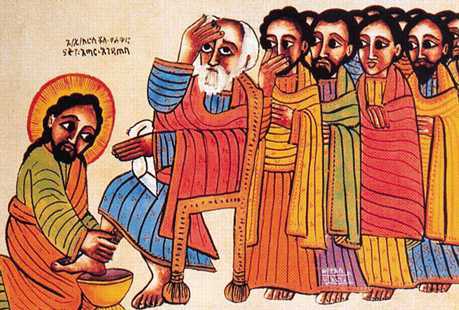
We have arrived once again to this beautiful and simple Thursday of Holy Week, the kickoff to the 3 holiest days of the church year. The Maundy Thursday foot washing is my absolute favorite service, but for some it is a source of—at best—discomfort and—at worst—distress. How is it that a bowl, a towel, and a pitcher of water can produce so much anxiety?

If the idea of washing feet makes you squeamish, you’re in good company. On that night 2,000 years ago, Peter felt much the same. As Jesus and the disciples gathered in the upper room, Jesus took his coat off, wrapped a towel around his waist, and began to wash his disciples’ dirt-covered, calloused feet. I can only imagine Peter staring in horror as Jesus made his way over to him. You see, washing feet was a slave’s responsibility, not the job of the Son of God. Peter initially refused to have his feet washed; he didn’t want to embarrass the man he believed was the Messiah. He had watched Jesus’ feet being washed by Mary just a few days before, and that was awkward enough. But Jesus told Peter that he must allow Jesus to wash his feet if he wanted any part in Jesus’ ministry.

In a way, foot washing is a reminder of baptism. In baptism our sins are forgiven and we receive the Holy Spirit; in baptism we are washed clean. Maybe Jesus knew that the disciples’ tired feet were going to see some rough days ahead and thought they could use some tender care. Maybe he knew that if they only gave but never received—if they never allowed themselves to be truly vulnerable with others—that they would never understand that all of us are in need of God’s grace, mercy, and love.

We Americans pride ourselves on our self-reliance. We boast about being self-made, about pulling ourselves up by our bootstraps, about not getting any handouts. We want people to think we have it all together. For us one of the worst things imaginable is the thought of having to rely on others to survive.

But no matter how much we desperately try to control things, the hard truth is that we can’t save ourselves. Despite what we post on Facebook, we don’t really have it all together. We are in need of saving; we are in need of a Savior.

Over the past few years I’ve watched my grandmother, who will be 94 in June, grow old gracefully. As she has aged she has gradually had to relinquish more and more of her independence. One of the first things to go was her car. Since none of her family lived nearby, friends and people from her church took turns taking her to doctor’s appointments, grocery shopping, and the gym. Rather than stay at home because she was embarrassed to ask for help, she allowed people to minister to her. She served her church faithfully for decades and then the roles were reversed.

In our culture of self-reliance, it’s easy to feel good when we do something nice for others and then go back to our regular, comfortable way of life. I’m guilty of this, too. But this top-down kind of service doesn’t cut it. The people we serve have something to offer us, too; we have to be willing to receive.

After Jesus washed the disciples’ feet, he shared the Passover meal with them. But this time it was different. Instead of the usual Passover phrases, after the blessing Jesus took the bread and told the disciples “this is My body” and then took the cup and told the disciples “this is My blood.” He told them to repeat this when they gathered together in the future, but this was more than just a reminder of who he was and what he practiced; Jesus knew he was going to die, so he gave his disciples a way to continue to have access to him beyond the grave.

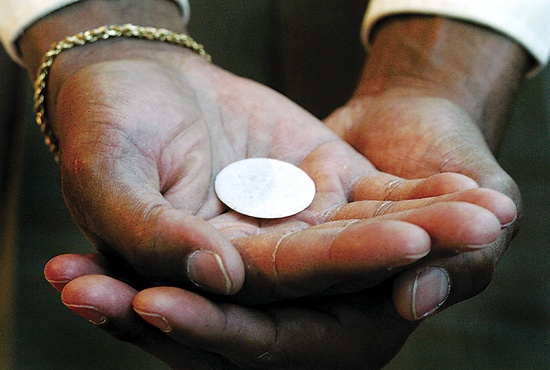
Jesus continues to give us access to him in the Eucharist, but the emphasis is not on us actively seeking him out. We like to be in control of our lives, but when it comes to Christ we have to give that control up, we have to let ourselves be vulnerable. In baptism we receive forgiveness and the Holy Spirit, and in the washing of feet we receive grace. Likewise, when we come to the table we don’t seize Christ, we don’t grab him with our hands, but we hold out our hands, palms open, and receive him. We are not doing to Christ, but letting Christ do unto us.

You’ve heard the saying, “You are what you eat.” When we take part in the Eucharist, when we open ourselves up to receive Christ’s body and blood, our makeup—the very essence of who we are—is fundamentally changed; we are literally becoming the Body of Christ.

And as we become the Body of Christ we are reminded not only of our need for Christ, but our need for each other. Now, as much as ever, it seems we need each other. We have to rely on one another, because we can’t build the kingdom on our own. God is calling us to put all of our individual gifts into the mix. After all, the kingdom of God is really about our interconnectedness, our interdependence, and our communion with God. 

Tonight let us not think of ourselves as the servant or even the served, but rather let us receive the spirit of God, receive the body of Christ, and together let’s receive one another so that we can more perfectly love as Christ loved us.

So be washed, be fed, and receive Christ.


foot washing image found here


Eucharist image found here