Saturday, August 20, 2011

sabbath

Okay, so in church/seminary circles, to talk of sabbath is cliche. We know it's a commandment, we know that we should be making time for it, but we secretly look down on people who take time off to just be, muttering to ourselves that if we didn't have so much to do, we could also make time for being. Or maybe that's just me.

Well, last May I finished my middler year (2nd of 3) of seminary physically, mentally, emotionally, and spiritually exhausted. It seems that all that doing had affected my well-being. And, to be honest, I wasn't doing very well at all. Junior year had led straight to CPE (Clinical Pastoral Education, basically an internship as a hospital chaplain), which had led straight to middler year--with hardly any time in between. For someone who has trouble saying no, and, as a result, has poor time management, having hardly any breaks built into to my schedule for me meant that I didn't really take time off. And because of that, things in my life started to fall apart. Life got exponentially harder, and I began to lose sight of myself. In this dark place I began to wonder what the heck I was doing here and what the purpose of it all was. Luckily, I recognized the signs of downward spiraling before I hit rock bottom, and with the support of some friends and my family (who also recognized the signs), got the help I needed. By the time May came around I was on my way to recovery, but life still had a lackluster hue.

Whether intentionally or because they are currently in transition, my diocese does not require anything of seminarians in the summer between middler and senior years. This ended up being a gift and a much-needed blessing for me. I slept, ate, watched all the episodes of the modern Dr. Who (currently in its 5th season), read for pleasure, played music, took lots of pictures, preached some, was a camp counselor for a week, went on a mission trip, and visited friends and family. In short, I took time to do things that I loved and only did what I wanted to do. And as the summer wore on, the layers of grime that had covered up my life began to wear away, revealing a colorful mosaic beneath it. I began to love life again but more importantly, I began to love myself. I returned to campus for my final (!) year of school refreshed, my faith restored, and full of joy and a new-found self-confidence. There's a fire in my belly and a song in my soul.

Now, in all likelihood, I won't get summers off every year. So it will be up to me to sprinkle little sabbaths throughout the year, making sure I do things for me. I guess that's part of growing up--getting to know (and love) yourself well enough that you take time to tend to your own needs, because *newsflash* no one is going to do it for you. Yes, I might miss out on a group activity here and there (there will be others). Yes, I might have to let people down now and then (it's bound to happen anyway). But, ultimately, I will be healthier, happier, more whole and a whole lot more pleasant to be around. This unassuming little commandment might just be one of the most important things I have learned in seminary.


Some sabbath pictures from this summer:
 Harry Potter and the beach: a winning combination.

 Taking time to enjoy the sunrise at Holden Beach, NC...

...and boy, is it glorious


 Grandfather Mountain, Boone, NC

Butterfly Garden on Grandfather Mountain

View from the mile-high "swinging" bridge

Thursday, July 14, 2011

letting go

Letting go.

It's such a familiar phrase. It's something that I've been attempting to do for as long as I can remember. It even inspired my word of the year (release). And until recently, it was something that I completely misunderstood.

I like to hold onto things. My pack-rat-ish tendencies include pictures, stamps, movie tickets, bulletins, programs...the list goes on and on. I hold onto them so that I can remember all of the good times. I'm terrified of forgetting, as if losing a memory means losing a part of me.

But there are certain memories that I try desperately to get rid of, attempting to scrub them away like I do a stain on a favorite shirt, or to bury them like a secret treasure, one I hope no one will ever find.

These memories, however, manage to crop up unexpectedly, no matter how hard I try to ignore them. And in some cases, the bad memories are linked inextricably to good ones, so in order to forget the bad I must also forget the good.

I thought that letting go meant forgetting. I thought that if I denied those parts of the past that I didn't wish to remember that they would lose their grip on me, would cease to be associated with me. But I was wrong. I'm starting to realize that they are never going to go away. But I am who I am today because of the things that happened and the choices I made, both good and bad. It may seem counter-intuitive, but claiming them as part of my story is actually what will release me from their grip. If I name them and acknowledge their presence, they will no longer have power over me, because they will be a part of me.

No one is all-good or all-bad. Everyone has things in their past that they would like to do over. But unless we know The Doctor, that is not an option for us. Besides, to quote an old Mac McAnally song, "If our plans had turned out like we wanted, would they be what we want right now?"

I've had some pretty amazing adventures in my life. If I erased part of my past, I wouldn't have gotten to do as many wonderful things or gotten to know people who are so dear to me now. I wouldn't be me.

This new realization doesn't mean that everything will magically get better. Letting go is still going to be difficult. Only now it actually seems possible.

Sunday, June 26, 2011

puzzled

Here's the sermon I preached at All Saints, Omaha, this weekend [click here for a link to the scripture]:

You know, I think it's a really good thing that the story of Abraham's sacrifice of Isaac didn't fall in the lectionary last week. When I try to think of good examples of fatherhood for Father's day, this passage is not at the top of my list, unless I'm going for irony.

At times I have trouble with some of the passages in the Bible. This is one of those times. I have heard the story repeatedly, and each time I get stuck on the same question: why? Why in the world would God ask Abraham to do something like this? After all that God has promised him, after all that Abraham has sacrificed in order to follow God's call, why would God ask him to sacrifice more? And his own child, for goodness' sake!

Let's take a look back at Abraham's life. The first time God calls Abraham, he picks up his wife, nephew, and servants and travels until God tells him to stop. Back then, your family and your land was everything. So for him to leave his extended family for the unknown meant that he was losing his identity. With his support system gone, he was relying completely on God.

God then promised him that he would have as many heirs as there are stars in the sky. And yet Abraham waited childless for 10 years before Sarah convinced him to take her slave-girl, Hagar, so that they would have someone to carry on the family name so it wouldn't disappear forever. Only after Ishmael is born does God finally tell Sarah that she is going to have a child of her own in the next few years. As Isaac grows older, Sarah becomes increasingly worried that Ishmael is a threat to Isaac's inheritance. In the passage immediately before the one we read today, Sarah tells Abraham to make Hagar and Ishmael leave. God tells him to listen to his wife. So he sends them off into the desert, what he believes to be a death sentence.

Abraham is understandably upset--Ishmael was his first-born, regardless of who his mother was. And right on the heels of this loss God decides to test him, to make him lose a son yet again. And Abraham listens! At this point, I begin to wonder what in the world is going on with Abraham. Where is the man who bargained with God for the lives of the people of Sodom and Gomorrah? If he could do that for complete strangers, for people who were corrupt and evil, why didn't he try to argue for the life of his own son? Why did he just blindly follow God's command?

We don't have answers to these questions. We just know that God called, and righteous man that he was, Abraham obeyed.

I wonder what the conversation is like between Abraham and his son as they leave the two servants behind on their way to make the sacrifice. Perhaps he is quiet, with a far-off gaze, nodding absent-mindedly as Isaac rambles on. Or maybe he is soaking up every last second with his precious son, absorbing their last bit of time together like a parched sponge. Or he could be trying to distract his son with tales of adventures from his journeys through foreign lands.

Whatever happens, Isaac is a smart kid, and, eventually noticing there isn't a lamb, he asks his father about it. Abraham answers him with the same response he gave God: "Here I am, my son."

And then, whether as a reply to pacify his son or a plea to God or an assertion of his faith, he tells his son in a voice cracking with emotion that "God himself will provide." As if to prove his point (to himself as well as his son), he begins to look around furtively, hoping against hope that there really is an animal somewhere out there.

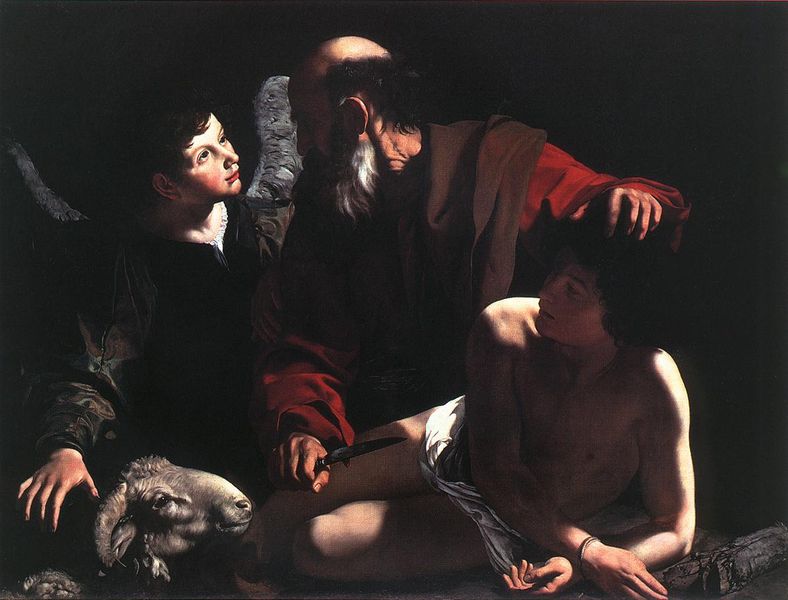
With each step the place gets closer and his heart grows heavier with the knowledge of what he is prepared to do. When they arrive I imagine Abraham is very particular about how the altar is built and fusses with the wood, stacking and re-stacking until it's obvious even to Isaac that his father is procrastinating. Scanning the area for an animal for the hundredth time and still finding none, his shoulders droop and he asks his son to come to his side. At this point he has probably run out of words--how in the world do you explain to your child that you are supposed to kill them? He ties up Isaac, who is so shocked that he doesn't try to resist, but simply stares in confusion at his father. Abraham puts him on top of the wood and reaches for his knife. His blood pounds in his ears loudly and he feels nauseated. He is so focused that the angel has to call his name twice to get his attention. "Abraham. Abraham!" He freezes, too afraid to move. He whispers hesitantly, "Here I am." And the angel tells him his son is not to die after all. He hears rustling behind him and sees a ram caught in a thicket. His hands shaking and tears streaming down his cheeks he hurriedly unties his son and then gathers him into his arms before they go collect the ram.

Obviously this is all a romanticized version stemming purely from my imagination. Maybe Abraham was completely certain that God would come and save Isaac. Maybe he talked to his son and told him exactly what to expect. I don't know about you, but I have personally never met anyone without an ounce of doubt on some level, whether or not they'll admit it out loud. And so I think that if this were the case it would take away from his sacrifice and the lengths to which he would go to in order to obey God's command.

Perhaps we get caught up in the drama of the situation and are too quick to write off Abraham as a shoddy father. But maybe as a final lesson to his son he was demonstrating the very thing he did best--and what he did best was obey God. For Abraham, God came first--before family, before identity, before everything. And this obedience, this righteousness, was an essential quality for the future people of God to have if they were going to be in covenant with one another. Because for some crazy reason, God wants to have a relationship with us.

We can't understand the reasons behind God's actions and requests. We only have a few pieces of the jigsaw puzzle, and we aren't able to see how they fit in with the rest of the pieces. We don't get to see the cover of the box, and that drives me absolutely crazy sometimes. So when I begin to get frustrated with God's request and how Abraham acts in this passage, I remind myself of a piece of the puzzle that is found way later in the Bible. Because the same God who makes this request of Abraham later ends up giving his own beloved Son as a sacrifice. And that's why we're here today: to join with our fellow brothers and sisters in Christ--old and new, from near and from far away--in a service of worship, fellowship, and thanksgiving for a God who we will never understand but who we do know loves us unconditionally. Thanks be to God!

Carvaggio's "Sacrifice of Isaac"

Friday, May 6, 2011

that very Spirit intercedes

The verse that has been close to my heart throughout this past school year has been Romans 8:26. The NRSV version reads, "Likewise the Spirit helps us in our weakness; for we do not know how to pray as we ought, but that very Spirit intercedes with sighs too deep for words."

If I am being honest, prayer does not always come easily to me. I'm not talking about prayer in church; surrounded by the voices of my faithful sisters and brothers it's easy for me to join in with confidence. I'm talking about the kind of prayer where I am sitting in my room on my bed, where it's just me and God...and lots of silence.

In my experience, God isn't always the best conversation partner, at least not in the traditional sense. So in the extended silence it's harder for me to feel assured that God is actually listening, or that my prayers even make a difference. I often end up feeling frustrated or like a failure. But I keep on trying. And sometimes, days--even weeks--later, I catch a glimpse of something or someone says something to me, and in that moment I know that even if what I prayed for has not come to pass, God really was listening the whole time.

Picasso

Monday, May 2, 2011

noticing the mess

He Qi's portrayal of "doubting" Thomas

Easter 2, Year A
John 20:19-32
St. Mark's

"Blessed are those who have not seen and yet have come to believe."

Every time we come to this Gospel passage I can't help but feel sorry for poor Thomas. In sermons he is often torn apart, scolded for his apparent lack of faith, forever dubbed "doubting Thomas." But can we really blame him?

Imagine it: A few days before, Jesus has been crucified. The disciples have spent the past three years following him, and less than 24 hours after his arrest, he is dead. It is hard enough to come to grips with the reality that all they have been working for is finished and that their lives are in even greater danger than before. But now Mary Magdalene and the other disciples are telling Thomas that they have seen Jesus, that he is back. Back from the dead? He'd seen Lazarus raised, but it was Jesus who had done that. So who raised Jesus? It is simply too impossible to believe something like this could happen.

So, Thomas responds the way I think any normal human being would respond, "Unless I see [him with my own eyes] I will not believe." And as the days go by without seeing Jesus, I imagine he becomes even more doubtful. Finally, though, after a week Jesus reappears, and this time Thomas is present. He sees the holes in Jesus' hands and side and responds with what is considered by some to be the most complete statement of faith in the New Testament: "My Lord and my God!"

To this, Jesus replies, "Blessed are those who have not seen and yet have come to believe."

I think it's important to remember that Thomas is not the only one of Jesus' followers who needed to see in order to believe that Jesus had been resurrected. Mary Magdalene begins to cry when she sees the empty tomb, thinking that Jesus' body has been stolen. Only when she hears her voice called and turns around does she realize that Jesus is the one speaking with her. Jesus then tells her not to cling to him but to go tell the others.

Similarly, Peter sees the empty tomb but doesn't believe until Jesus appears in the locked room. And the disciples only begin to rejoice after Jesus proves it's him by showing them the marks on his hands and side. In fact, the only person in this passage that believes without seeing is "the disciple whom Jesus loved."

"Blessed are those who have not seen and yet have come to believe." These words must have been a great comfort to the people who first heard them. The Gospel according to John was probably written 40-60 years after Jesus had died. This means that most of the people who had been present during his lifetime were no longer living. These words, in a sense, spoke directly to them, encouraging them to believe and promising them blessings if they did.

Even though they faced persecution, in a sense, I think faith came easier to the first generations of Christians than it does for us in the 21st century. After all, they at least knew someone who knew Jesus, or knew someone who knew someone who knew Jesus. We are so much farther removed. The only things we have to go by are the words written in the Bible and a tradition handed down for about 2000 years. There seems to be more room for doubt with each passing generation.

But keep in mind that it is natural for people to have questions, to wonder, to struggle with their faith. As a matter of fact, I dare you to find one person who has never had any doubts in their entire life. Even the Bible is filled with examples of people who struggled with their faith. It is precisely in the struggles where our faith has the chance to grow, to deepen.

In her book, Further Thoughts on Faith, Anne Lamott writes, "the opposite of faith is not doubt, but certainty. Certainty is missing the point entirely. Faith includes noticing the mess, the emptiness and discomfort, and letting it be there until some light returns."

I experienced some of this in college. My campus ministry, WCF, was made up of people of various denominations, mostly Presbyterian and Episcopalian. Other than being small, as far as I know we were a pretty typical Christian group--we got together once a week to share a meal, pray, and hang out. One of my friends, who had spent time with other ministry groups on campus before joining ours, said that he felt more comfortable in our group. He said that with the others, there was an expectation that everyone believe the same thing. It was black and white--you either believed what they did or you didn't, and if you didn't believe, then you didn't belong. But at WCF, it was okay for people to be unsure, to be, as he said, "in the gray spaces" of faith. At WCF we didn't have to feel guilty for questioning or pretend to believe in something we didn't. We could just be ourselves, and that was good enough. 

I think this is true of St. Mark's and the Episcopal Church in general. It's one of the main reasons I love it so much. I think that most of us are here today because there is something about Jesus that draws us in, a sense of truth that resonates deep within our hearts. Our faith might be shaky at times. Maybe it's shaky today. What I think this passage is ultimately trying to tell us, however, is that it's okay not to be 100% sure of what we believe all the time. Where we fall short, the Holy Spirit fills in for us. And it's why we come here, week after week: to find strength in common worship in prayer, to be nourished by Christ's body and blood, and to be re-energized to go out of these doors together to share the great, impossible news with the world that our Lord and our God has risen from the dead.

Alleluia! Christ is risen!
The Lord is risen indeed, Alleluia!

Friday, April 22, 2011

present-day stations of the cross

Well, it's been a while, but I suppose there's no time like Good Friday to begin writing/sharing again...

Two or three years ago in Lent I posted (on a different blog) the stations of the cross with pictures of everyday people instead of Jesus. It was a good spiritual practice for me, so I decided to try it again with new images. Why? I believe that God suffers every time one of God's creation suffers, and so this is my attempt to see Christ in the world around me. On Good Friday, I think it's especially important to remember those around the world who are suffering. And so, without further ado, I give you this year's rendition (taken from Google images).

Stations of the Cross

First station: Jesus is condemned to die

final stop of death row

Second station: Jesus takes up his cross


Third station: Jesus falls the first time


Fourth station: Jesus meets his afflicted mother


Fifth station: The cross is laid on Simon of Cyrene


Sixth station: A woman wipes the face of Jesus

 bird being cleaned after oil spill

Seventh station: Jesus falls a second time


Eighth station: Jesus meets the women of Jerusalem

 woman in Haiti

 women in Libya praying

Ninth station: Jesus falls a third time


Tenth station: Jesus is stripped of his garments


Eleventh station: Jesus is nailed to the cross


Twelfth station: Jesus dies on the cross

 nuns killed during the civil war in El Salvador

Thirteenth station: The body of Jesus is placed in the arms of his mother

a Sudanese woman closing the eyes of her child


a woman mourning the death of her child in Iraq


Fourteenth station: Jesus is laid in the tomb


hanging coffins in the Philippines 
"Grant, O God, that your holy and life-giving Spirit may so move every human heart, that barriers which divide us may crumble, suspicions disappear, and hatreds cease; that our divisions being healed, we may live in justice and peace; through Jesus Christ our Lord. Amen."  BCP p. 823

Monday, October 25, 2010

resurrection people

Today we had our first noonday Eucharist since the fire on Friday. We worshiped in the chapel down the street, and while it was strange to be in a different place, it was nice to have been offered a place to worship. The dean spoke, and he just has a really great way of putting things. [I'll post his sermon once it appears on the school's website] He reminded us that although we aren't in the same place, we are with the same people, reading familiar words, singing familiar songs, and praying familiar prayers. He said that we won't ever know why this world was created with the need for healing, but we do know that Christ steps in and provides that healing, over and over again. And in our service, we continue to give thanks for all that God does for us.

Bishop Johnston (of VA) spoke to us as well. He said that he mourned with us, and that people all over the world were praying for us. I was once again overwhelmed with the knowledge that so many people in so many places were and have been taking time out of their day to check in on us or to mention us in their prayers. The generosity of the surrounding communities (specifically Immanuel Church-on-the-Hill's Zabriskie Chapel, Episcopal High School, and even Beth El Hebrew Congregation!) has been especially moving. The Bishop called us to be a "Resurrection people," a people continuing the witness of Christ's work in the world despite--no, because of--our loss. He then highlighted the second verse of the song we were about to sing, All My Hope on God is Founded (Hymn 665 in our hymnal, but this British version has slightly different words. Here's the words from our hymnal: "...though with care and toil we build them, tower and temple fall to dust. But God's power, hour by hour, is my temple and my tower"). I can't really expand on that--the words speak for themselves.

Since getting back to campus on Saturday night, I have sensed a change within the community and within me. The briefing by the Dean was followed by Evening Prayer and then community dinner. It made my heart glad to see so many people--even spouses and commuters!--eating together. As my friend Liz said, "We do community really well," and this has only been amplified. There's an intentionality, a richness around everything--especially things that happen in church. At my field ed church yesterday I noticed the loud crack when the celebrant broke the Host at the Eucharist. It was almost as if something inside me had snapped, as if I could sense for the first time what the words "this is my Body, broken for you" really mean. And today at the Eucharist we sang louder and spoke with more conviction than ever before.

There is no doubt in my mind that we are witnessing to the light, that we truly are being "Resurrection people."